Every D2C founder says the same thing: "We'll automate later. Right now, spreadsheets work." They don't. You just don't see the bleeding until you do the math.
Manual order processing isn't free. It's the most expensive system you're running — you just haven't built a P&L around it yet. When your team spends 4+ hours a day copying data between Shopify admin, Google Sheets, WhatsApp, and courier dashboards, that's not operations. That's an invisible tax on every order you ship.
Important
Indian D2C brands processing 500+ orders/day lose an estimated ₹2-5 lakh per month to manual operations. This isn't salaries — it's errors, missed SLAs, duplicate shipments, and opportunity cost.
The Hidden Cost Framework
Most founders calculate operations cost as: Salaries + Software + Courier Fees. That's the visible layer. Below it sits a much larger iceberg of hidden costs that never show up on any dashboard.
Layer 1: Direct Time Waste
Let's map a typical day for a 3-person operations team managing 800 orders on Shopify:
| Task | Time per Day | Monthly Hours | Monthly Cost (₹15K/person) |
|---|---|---|---|
| Export orders from Shopify to CSV | 20 min | 10 hrs | ₹940 |
| Update Google Sheets with status | 45 min | 22.5 hrs | ₹2,110 |
| Copy-paste tracking IDs to Shopify | 60 min | 30 hrs | ₹2,810 |
| Manual inventory checks across stores | 30 min | 15 hrs | ₹1,400 |
| WhatsApp message typing (non-templated) | 90 min | 45 hrs | ₹4,220 |
| End-of-day reporting & reconciliation | 40 min | 20 hrs | ₹1,870 |
| Total | 4 hrs 45 min | 142.5 hrs | ₹13,350 |
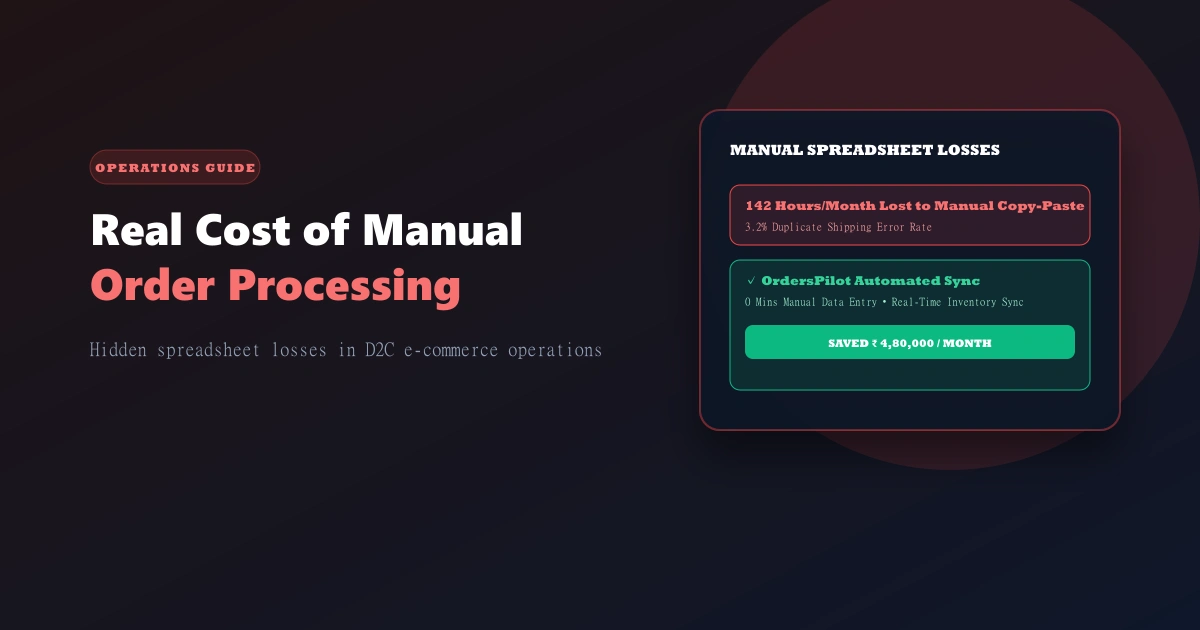
That's 142.5 hours per month of pure data-moving — not decision-making, not customer service, not strategy. Just copying information from one screen to another.
And that's just one team. Scale to 2,000 orders/day and multiply everything by 2.5x.
Layer 2: Error Costs
Manual processes don't just waste time. They create errors. Each error has a direct cost:
Duplicate Shipments: When two team members process the same order from stale spreadsheet data, you ship twice. Cost: product + double shipping + return logistics.
- Frequency: 1-3% of orders at scale
- Per-incident cost: ₹400-800
- Monthly impact at 800 orders/day: ₹96,000-₹576,000
Wrong Address Shipments: Copy-paste errors in addresses lead to failed deliveries and RTOs.
- Frequency: 0.5-1.5% of manually processed orders
- Per-incident cost: ₹200-400 (round-trip shipping + reprocessing)
- Monthly impact: ₹24,000-₹144,000
Inventory Overselling: Without real-time sync across Shopify stores, you sell products you don't have.
- Frequency: 2-5% of SKUs experience overselling monthly
- Per-incident cost: ₹150 (refund processing + customer trust damage)
- Monthly impact: ₹18,000-₹45,000
Warning
The scariest cost isn't the error itself — it's the compounding customer trust damage. A customer who receives a duplicate shipment or a "sorry, out of stock" email after payment doesn't just leave. They leave a 1-star review that costs you 30 future customers.
Layer 3: Opportunity Cost
This is the biggest number no one tracks.
Your operations manager — the person who understands your supply chain, courier relationships, and customer patterns — spends 60% of their day on data entry. That's a ₹50,000/month hire doing ₹15,000/month work.
What could they do instead?
- Negotiate better courier rates (savings: ₹30,000-₹80,000/month)
- Identify and fix RTO patterns (savings: ₹50,000-₹200,000/month)
- Optimize inventory purchasing (savings: ₹40,000-₹100,000/month)
Opportunity cost per month: ₹1,20,000 - ₹3,80,000
The Total Damage: A Real Calculation
Let's put it together for a Shopify D2C brand doing 800 COD orders/day:
| Cost Category | Conservative | Realistic |
|---|---|---|
| Direct Time Waste | ₹13,350 | ₹26,700 |
| Duplicate Shipments | ₹96,000 | ₹2,88,000 |
| Wrong Address RTOs | ₹24,000 | ₹72,000 |
| Inventory Overselling | ₹18,000 | ₹45,000 |
| Opportunity Cost | ₹1,20,000 | ₹3,80,000 |
| TOTAL MONTHLY LOSS | ₹2,71,350 | ₹8,11,700 |
That's ₹2.7 lakh to ₹8.1 lakh per month leaking from your business. Not to courier fees. Not to ad spend. To copying and pasting.
The Five Stages of Manual Operations Breakdown
Every growing Shopify brand hits these stages:
Stage 1: "It's Fine" (0-100 orders/day)
One person handles everything. Shopify admin + one spreadsheet. It actually works. This is the dangerous stage because it creates the illusion that manual processes scale.
Stage 2: "We Need More People" (100-500 orders/day)
You hire 2-3 operations people. They share a Google Sheet. Conflicts start — two people updating the same row, stale data, "I already shipped that." You solve problems by adding WhatsApp groups.
Stage 3: "The Spreadsheet is Broken" (500-1,000 orders/day)
Google Sheets lags with 10,000+ rows. Formulas break. Someone accidentally deletes a column. You move to Airtable or Notion. Same problems, prettier interface. You start missing SLAs.
Stage 4: "We're Losing Money" (1,000-2,000 orders/day)
Errors compound. RTOs spike because addresses aren't verified. Inventory oversells because sync is manual. Your best operations person quits because they're bored of data entry. You realize you need a system.
Stage 5: "We Should Have Done This Earlier" (2,000+ orders/day)
You implement an OMS like OrdersPilot. Within 2 weeks, your team processes 3x the volume with the same headcount. You wonder why you waited so long.
Tip
Most brands implement an OMS at Stage 4 when they're already losing money. The smartest brands do it at Stage 2 when the cost is lowest and the habits are easiest to change.
What Automation Actually Looks Like
Moving from manual to automated isn't about replacing people. It's about giving them tools that eliminate busywork.
Before: Shopify → CSV → Spreadsheet → Manual Entry
- Export orders from Shopify admin (daily, manual)
- Copy into master Google Sheet
- Calling team works from the sheet
- Status updates typed manually
- Tracking IDs copy-pasted back to Shopify
- End-of-day reconciliation
After: Shopify → OrdersPilot → Everything Automated
- Orders sync from Shopify in real-time via webhooks
- Calling queue auto-populated and prioritized
- One-click confirmations update everything
- Labels generated automatically via courier APIs
- Tracking auto-synced to Shopify and customer WhatsApp
- Real-time dashboards replace end-of-day reports
Time saved per day: 4+ hours Errors eliminated: 95%+ Orders processed per person: 2x increase
The ROI Math: OrdersPilot vs. Manual
| Metric | Manual (Spreadsheets) | With OrdersPilot |
|---|---|---|
| Orders/person/day | 150-200 | 400-500 |
| Processing errors | 3-5% | <0.5% |
| Data entry hours/day | 4-5 hours | 0 hours |
| Inventory sync delay | 4-24 hours | Real-time |
| Label generation | Manual (courier dashboard) | One-click bulk |
| MONTHLY SAVINGS | ₹2,50,000 - ₹5,00,000+ | |
How to Make the Switch (Without Breaking Anything)
Transitioning from manual to automated doesn't mean flipping a switch overnight. Here's the phased approach we recommend:
Week 1: Connect Shopify
- Create a Shopify custom app and generate API credentials
- Set up webhooks for real-time order sync
- Import existing orders and inventory data
Week 2: Migrate the Calling Team
- Move from spreadsheet queues to OrdersPilot's confirmation dashboard
- Set up WhatsApp templates for one-click messaging
- Train agents on the new workflow (typically takes 1-2 days)
Week 3: Automate Fulfillment
- Connect courier partners (Delhivery, Shiprocket)
- Enable automated label generation
- Set up tracking sync back to Shopify
Week 4: Kill the Spreadsheet
- Run both systems in parallel for 3 days to verify accuracy
- Retire the Google Sheet
- Set up real-time analytics dashboards
Tip
The biggest resistance to automation comes from the team, not the technology. Involve your operations team early. Show them how the new system makes their job easier, not how it replaces them. The best implementations are driven by the team that uses it daily.
Frequently Asked Questions (FAQ)
1. How much does manual order processing really cost?
For a Shopify D2C brand processing 500-1,000 orders daily, manual operations cost ₹2-5 lakh per month in hidden losses — including time waste, duplicate shipments, wrong address RTOs, inventory overselling, and opportunity cost. This doesn't include salaries, which are a separate line item.
2. When should I switch from spreadsheets to an OMS?
The ideal time is when you're processing 100-200 orders per day. At this stage, the implementation cost is low and the habits are easy to change. Most brands wait until 1,000+ orders/day when they're already bleeding money, making the transition more painful and urgent.
3. How does OrdersPilot integrate with Shopify?
OrdersPilot connects to your Shopify store via custom app APIs and webhooks. Orders sync in real-time, inventory updates flow bidirectionally, and fulfillment status is automatically pushed back to Shopify. Setup typically takes under 30 minutes per store.
Related Guides
- How to Setup Shopify Webhooks for Real-Time Automation: The technical foundation for eliminating manual data sync.
- Building a High-Performance Calling Team: Once you automate data entry, optimize your team's actual work.
- Scaling D2C Operations: From 500 to 5,000 Orders Per Day: The bigger picture of scaling beyond manual processes.
Ready to stop paying the manual processing tax? Schedule a demo to see how OrdersPilot eliminates spreadsheet chaos and saves your team 4+ hours every single day.
Author
Growth Team
Deeply passionate about optimizing e-commerce logistics and building systems that help D2C founders regain control of their operations.
Enjoyed this article?
If you found this helpful, share it with your network and help other Shopify founders scale their operations.
Recommended Articles
Continue your journey with more insights from our team.