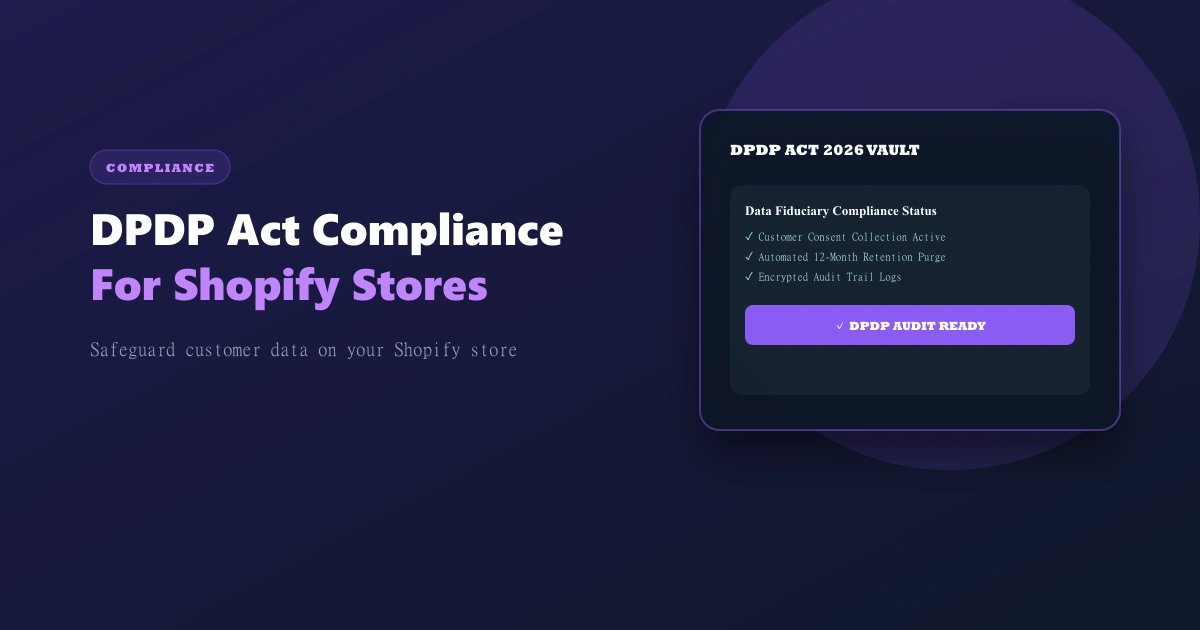
If you're running a Shopify store targeting Indian customers, you're now subject to the Digital Personal Data Protection (DPDP) Act. And "we'll deal with compliance later" is no longer an option — the Act is enforced, penalties are steep (up to ₹250 crore), and the data you collect through every single order makes you a "Data Fiduciary" under the law.
The good news: compliance isn't as complex as GDPR. The bad news: most D2C brands have no idea what data they're collecting, where it's stored, or how long they're keeping it. This guide fixes that.
Caution
The DPDP Act carries penalties of up to ₹250 crore for significant non-compliance. Even smaller violations can attract penalties of ₹10,000-₹50 crore depending on the nature and scale of the breach. This is not hypothetical — enforcement is active.
What the DPDP Act Means for Shopify Brands
The DPDP Act governs how businesses collect, store, process, and delete digital personal data of Indian citizens. For a Shopify D2C brand, here's what qualifies as personal data:
Data You Collect Through Every Order
| Data Type | Where It's Collected | Classification |
|---|---|---|
| Customer name | Shopify checkout | Personal Data |
| Phone number | Checkout + WhatsApp confirmation | Personal Data |
| Email address | Checkout + marketing opt-in | Personal Data |
| Shipping address | Checkout | Personal Data |
| Payment method | Payment gateway | Sensitive Personal Data |
| Order history | Shopify admin | Personal Data |
| IP address | Website analytics | Personal Data |
| Device/browser info | Analytics scripts | Personal Data |
| WhatsApp chat logs | Confirmation workflows | Personal Data |
| Call recordings | Calling team systems | Personal Data |
Key insight: If you're using an OMS, calling team software, WhatsApp Business API, and analytics tools — you're collecting personal data in at least 5-8 different systems. Each one needs to be compliant.
The 5 Compliance Pillars for D2C Brands
Pillar 1: Lawful Purpose & Consent
The rule: You can only collect personal data for a specific, clearly stated purpose. And the customer must give informed consent before you collect it.
What this means for Shopify:
Checkout data: This is covered under "legitimate use" — you need the name, address, and phone number to fulfill the order. No separate consent required for order fulfillment.
Marketing data: This requires explicit opt-in consent. Your Shopify checkout's "Subscribe to newsletter" checkbox? That's consent — but only if:
- It's unchecked by default (pre-checked boxes don't count)
- The purpose is clearly stated ("Receive promotional offers via email")
- The customer can withdraw consent easily
WhatsApp confirmations: If you're sending order confirmation messages via WhatsApp, that's operational and covered under legitimate use. But promotional WhatsApp messages (sale announcements, new product launches) require separate marketing consent.
Calling team recordings: If your calling team records calls for quality assurance, you must inform the customer at the start of the call. "This call may be recorded for quality purposes" — standard practice, but now legally mandatory.
Tip
Shopify Implementation: Use Shopify's checkout customization to add a clear, unchecked consent checkbox for marketing communications. Store the consent timestamp in customer metafields so you have an audit trail.
Pillar 2: Data Minimization
The rule: Only collect data that's necessary for your stated purpose. Don't hoard data "just in case."
Common violations in D2C:
- Collecting date of birth at checkout (you don't need it to ship a t-shirt)
- Requiring Aadhaar or PAN for COD orders (not necessary for fulfillment)
- Storing full payment card details (your payment gateway handles this — you shouldn't)
- Keeping customer data indefinitely after order completion
What to audit:
- Review your Shopify checkout fields — remove anything non-essential
- Check your custom forms and pop-ups for unnecessary data collection
- Review what your analytics tools track beyond what you actually use
- Audit third-party apps installed on your Shopify store
Pillar 3: Data Retention & Deletion
The rule: Personal data must be deleted when it's no longer needed for the purpose it was collected. You can't keep customer data forever.
This is where most D2C brands fail. Your Shopify store has orders from 3 years ago with full customer details. Your Google Sheets have customer phone numbers from campaigns that ended 18 months ago. Your WhatsApp Business has chat logs going back to launch.
Recommended retention periods for D2C:
| Data Type | Retention Period | Reason |
|---|---|---|
| Order fulfillment data | 3 years | Tax/accounting requirements |
| Customer contact info (active) | Until consent withdrawn | Ongoing relationship |
| Customer contact info (inactive) | 12 months after last order | Reasonable retention |
| Marketing consent records | Duration of consent + 1 year | Audit trail |
| Call recordings | 90 days | Quality assurance window |
| WhatsApp chat logs | 6 months | Operational reference |
| Analytics/cookie data | 13 months | Analytics reporting cycle |
| Payment data | Don't store it | Use tokenized gateway |
Warning
The "Delete" Problem with Shopify: Shopify doesn't automatically delete old customer data. You need to implement a process — either manual or automated — to identify and purge customer records past your retention period. OrdersPilot can flag customers who haven't ordered in 12+ months for review.
Pillar 4: Customer Rights
The rule: Customers have the right to:
- Access their data (know what you've collected)
- Correct inaccurate data
- Delete their data (right to erasure)
- Withdraw consent for marketing
- Nominate someone to exercise rights on their behalf (e.g., in case of death)
What this means operationally:
When a customer emails asking "What data do you have on me?" — you need to respond within a reasonable timeframe with a complete answer. This means you need to know where their data lives across all your systems:
- Shopify admin (orders, profile)
- OMS (confirmation status, agent notes)
- WhatsApp Business (chat history)
- Email marketing tool (engagement data)
- Analytics platforms (behavioral data)
When a customer requests deletion:
- Remove from Shopify customer list (or anonymize)
- Delete from OMS records
- Remove from WhatsApp broadcast lists
- Unsubscribe from email marketing
- Anonymize analytics data
This is significantly easier when your data flows through a centralized OMS rather than being scattered across 8 different tools.
Pillar 5: Data Breach Notification
The rule: If a data breach occurs, you must notify the Data Protection Board of India and affected individuals without delay.
For Shopify brands, breach risks include:
- Shared Google Sheets with customer data accessible to former employees
- WhatsApp groups where order details (customer names, addresses, phone numbers) are shared
- Unsecured CSV exports on local machines
- Third-party Shopify apps with excessive data access permissions
Preventive measures:
- Audit Shopify app permissions — remove apps you don't actively use
- Stop sharing customer data via WhatsApp groups — use a proper OMS
- Encrypt CSV exports or better yet, stop exporting to CSV entirely
- Implement role-based access — not everyone needs to see full customer details
- Use 2FA on all admin accounts (Shopify, OMS, email marketing)
Important
The most common "breach" vector for D2C brands isn't hackers — it's the shared Google Sheet with 50,000 customer phone numbers that a former intern still has access to. Centralize data in systems with proper access controls.
The Shopify-Specific Compliance Checklist
Here's your action plan, ordered by priority:
Immediate (This Week)
- Add unchecked marketing consent checkbox to Shopify checkout
- Add privacy policy link to checkout footer
- Review and remove unnecessary checkout fields
- Audit installed Shopify apps — remove unused ones
- Enable 2FA on all admin accounts
Short-Term (This Month)
- Create/update your Privacy Policy page (link from footer)
- Set up customer data request handling process
- Implement email unsubscribe mechanism (one-click)
- Stop sharing customer data via WhatsApp groups/spreadsheets
- Implement role-based access in your OMS
Medium-Term (This Quarter)
- Define data retention periods for each data type
- Build automated process to flag/purge old customer data
- Audit third-party data sharing (analytics, ad platforms, courier APIs)
- Train team on data handling procedures
- Document your data processing activities
How OrdersPilot Helps With Compliance
OrdersPilot centralizes your order data — which means centralizing your compliance surface area. Instead of managing customer data across Shopify + Google Sheets + WhatsApp + courier dashboards, everything flows through one system with:
Access controls: Role-based permissions mean your calling agent sees the customer name and phone number, but not their full order history or payment details.
Audit trails: Every action on customer data is logged — who accessed what, when, and why.
Data lifecycle: OrdersPilot can flag customer records past your retention threshold for review and deletion.
Reduced spreadsheet exposure: When you stop exporting CSVs and sharing Google Sheets, you eliminate the #1 breach vector for D2C brands.
Frequently Asked Questions (FAQ)
1. Does the DPDP Act apply to my Shopify store?
Yes, if you collect personal data from Indian customers — which every Shopify store does through checkout (name, address, phone, email). The Act applies to all digital personal data processed within India, regardless of your business size or where your servers are located (Shopify's servers are in the US/Canada).
2. Do I need consent for sending order confirmation messages?
Order confirmations and shipping updates are covered under "legitimate use" and don't require separate consent. However, promotional messages (sale announcements, new product marketing) require explicit opt-in consent from the customer.
3. What happens if a customer asks me to delete all their data?
You must comply within a reasonable timeframe. Delete or anonymize their data across all systems — Shopify, OMS, email marketing, WhatsApp. Note that you can retain data required for legal/tax obligations (e.g., invoice records for 3 years under GST law), but the customer's marketing data and non-essential records must be removed.
Related Guides
- How to Create a Shopify Custom App & Generate API Keys: Secure API setup is a foundational compliance measure.
- Managing Multiple Shopify Stores From One Dashboard: Centralized data management simplifies compliance across stores.
- Building a High-Performance Calling Team: How to handle call recordings and agent data access compliantly.
Need help centralizing your customer data for DPDP compliance? Schedule a demo to see how OrdersPilot gives you access controls, audit trails, and a single source of truth for every customer interaction.
Author
Growth Team
Deeply passionate about optimizing e-commerce logistics and building systems that help D2C founders regain control of their operations.
Enjoyed this article?
If you found this helpful, share it with your network and help other Shopify founders scale their operations.
Recommended Articles
Continue your journey with more insights from our team.