Important
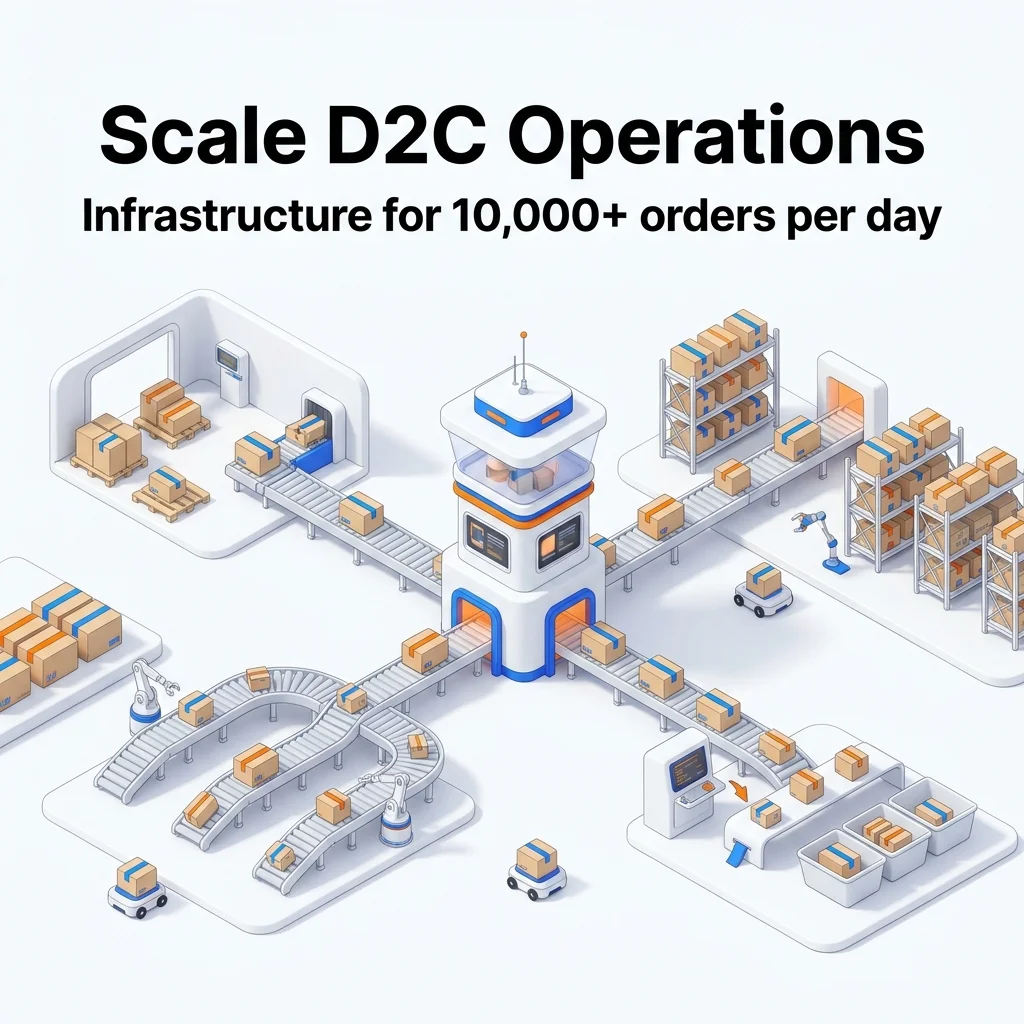
Scaling isn't just about spending more on ads. It's about ensuring your backend operations—calling, inventory, and fulfillment—can handle the volume without breaking.
Scaling a D2C brand from 500 orders/day to 5,000 orders/day is a 10x growth. Most founders think it means hiring 10x more people. It doesn't. With the right systems, you scale maybe 3-5x headcount and 10x output.
The difference between chaos and control is infrastructure.
OrdersPilot customers have scaled to 5,000+ orders/day. By aligning automated fulfillment strategies through custom integrations (such as the standard Shopify API Documentation), we have seen what breaks and what holds. Here's the playbook.
The Scaling Phases
Phase 1: 500-1,000 Orders/Day (Founder-Led)
Characteristics:
- Founder doing operations themselves
- 1-2 spreadsheets for order management
- 2-3 part-time calling agents
- Shipping via WhatsApp
- "Things are manageable"
When You Hit the Wall:
- Founder can't keep up with data consolidation
- Calling team is confused about order priority
- Inventory is never accurate
- RTO rate spikes (18%+) as volume increases
What You Need:
- Unified order management system (OrdersPilot or similar)
- Structured calling team process
- Real-time inventory sync
Example Timeline:
- Month 1-3: Manual spreadsheets work (ish)
- Month 4-6: Spreadsheets are chaotic, founder frustrated
- Month 7: Implement OrdersPilot, chaos subsides
- Month 8-12: Stable 800 orders/day with 3 agents + founder oversight
Phase 2: 1,000-2,500 Orders/Day (Scaling Operations)
Characteristics:
- Dedicated operations manager hired
- OrdersPilot or similar system in place
- 5-8 calling agents (full-time)
- Inventory still manually reconciled weekly
- Fulfillment center (warehouse) established
- RTO rate improving (14-16%)
When You Hit the Wall:
- Operations manager overwhelmed with edge cases
- Calling team quality varies (7-16% RTO rates)
- Inventory conflicts between teams (warehouse says out of stock, Shopify says in stock)
- Multi-brand expansion starts but feels chaotic
What You Need:
- Performance management system (metrics tied to pay)
- Automated inventory syncing (not manual)
- Multi-brand functionality
Example Timeline:
- Month 1-3: Hire ops manager, implement OrdersPilot
- Month 4-6: Calling team stabilizes, RTO improves to 12-14%
- Month 7-9: Add multi-brand, hit coordinating complexity
- Month 10-12: Full automation of inventory and calling workflow
Key Mistake: Hiring more agents without improving systems. You'll hire 10 agents instead of 6, but RTO will remain 12%. Instead: automate first, then hire.
Phase 3: 2,500-5,000 Orders/Day (Infrastructure Phase)
Characteristics:
- 3-5 Shopify stores (multi-brand)
- 15-25 calling agents organized into shifts
- Dedicated fulfillment center with real warehouse (not garage)
- Real-time inventory across all stores
- OrdersPilot managing all order flows
- RTO rate optimized (8-10%)
When You Hit the Wall:
- Warehouse becomes bottleneck (picking/packing can't keep up)
- Calling team coordination across shifts breaks down
- Inventory syncing has delays (24-48 hours behind actual stock)
- Support tickets spike (customers can't track orders)
What You Need:
- Warehouse management system (WMS) integration
- Shift-based calling team management
- Real-time inventory (true real-time, not batch syncs)
- Customer self-service portal (tracking, refunds, etc.)
Example Timeline:
- Month 1-3: Stabilize at 3,000/day, optimize calling team
- Month 4-6: Set up warehouse management, integrate with OrdersPilot
- Month 7-9: Add shift-based calling (day shift, evening shift)
- Month 10-12: Hit 5,000 orders/day, still controllable
Phase 4: 5,000+ Orders/Day (Enterprise Scale)
You're now a logistics operation, not a "D2C brand." You need:
- Multi-location fulfillment (different warehouses for different regions)
- AI-driven demand forecasting
- Predictive RTOs
- International expansion capabilities
This is beyond typical OrdersPilot use. You're scaling into logistics infrastructure.
Critical Infrastructure Decisions
1. Calling Team Structure
At 1,000 orders/day:
- 1 Calling Lead + 3-4 agents
- Single shift (9 AM - 6 PM)
- Orders confirmed during business hours
At 2,500 orders/day:
- 1 Calling Lead + 8-10 agents
- Single shift still works (9 AM - 6 PM)
- But some orders slip unconfirmed into next day
At 5,000 orders/day:
- 1 Lead + 2 Supervisors + 20-25 agents
- Two shifts: Day (9 AM - 6 PM) + Evening (5 PM - 1 AM)
- Staggered breaks so queue is always staffed
Why two shifts? Orders come in 24/7. If you only confirm during business hours, evening orders have 0% confirmation rate. Customers never hear back, abandon orders, RTOs spike.
Two shifts = 95%+ confirmation rate across all hours.
2. Inventory Architecture
At 1,000 orders/day:
- Manual inventory reconciliation weekly
- Spreadsheet of stock levels
- Overselling happens 2-3 times/month (customer refund)
At 2,500 orders/day:
- Daily inventory reconciliation (end of day)
- OrdersPilot syncs inventory from Shopify in real-time
- Overselling reduced to near-zero
At 5,000 orders/day:
- Real-time inventory (no batch syncs)
- OrdersPilot reserved inventory: "confirmed but not yet packed" orders are locked in
- Overselling: zero (impossible to happen)
- Manufacturing sync: production team can see "we have 40 units confirmed for next week, start making"
Without real-time inventory at scale, you'll oversell 5-10 orders/day at 5K orders/day volume. That's 50-100 refunds/week, 5-10% of revenue.
3. Fulfillment Workflow
At 1,000 orders/day:
- Garage or small office space
- 2-3 warehouse staff
- Manual picking (read order, grab product)
- Manual packing
- Manual label creation
At 2,500 orders/day:
- Dedicated small warehouse (500-1,000 sq ft)
- 5-8 warehouse staff
- Zones (picking area, packing area, staging)
- OrdersPilot generates labels in batches
- Faster: labels are ready before orders reach packing
At 5,000 orders/day:
- Dedicated warehouse (2,000+ sq ft)
- 15-20 warehouse staff (organized into teams)
- WMS (Warehouse Management System) integration with OrdersPilot
- Mobile barcode scanning (pick, scan, pack, scan, ship)
- Conveyor belts for high-volume sorting
- Staging area for 24-hour batch shipments
Cost math:
- Garage space: ₹10K-20K/month, 1 person, slow (2 hours to pick/pack 500 orders)
- Small warehouse: ₹50K-100K/month, 8 people, fast (20 minutes to pick/pack 500 orders)
- Large warehouse: ₹200K-300K/month, 20 people, super fast (10 minutes to pick/pack 500 orders)
The larger warehouse costs 3x but processes orders 12x faster. At scale, it's the only way.
4. Customer Support
At 1,000 orders/day:
- Founder handles customer emails/WhatsApp
- Average response time: 12 hours
- Customer satisfaction: 70%
At 2,500 orders/day:
- 1 customer support person
- Response time: 4 hours
- Satisfaction: 78%
At 5,000 orders/day:
- 2-3 support people + self-service portal
- Response time: 1 hour
- Self-service (order tracking, refund status): 40% of customers use it
- Satisfaction: 88%
Why self-service matters at scale: At 5,000 orders/day, 10% of customers have questions. That's 500 support requests/day. You can't have humans answer all of them. Self-serve portal handles 60% (tracking, refund status, returns). Humans handle the other 40% (product questions, exceptions).
OrdersPilot handles this: customers can track orders, view refund status, request returns—all without contacting support.
The Bottleneck Sequence
As you scale, bottlenecks emerge in a predictable order. Prepare for each:
| Volume | Bottleneck | Solution |
|---|---|---|
| 500 → 1,000 | Order management is manual | Implement OrdersPilot |
| 1,000 → 2,500 | Calling team coordination | Performance metrics + shift structure |
| 2,500 → 5,000 | Inventory accuracy | Real-time syncing |
| 5,000 → 10,000 | Warehouse speed | WMS + mobile scanning |
| 10,000 → 20,000 | Logistics capacity | Multi-warehouse + regional shipping |
Pro tip: Identify the next bottleneck 3 months before you hit it. Implement the solution as you approach, not after you're in crisis mode.
Real Example: Eliora's Scale Journey
Month 1 (500 orders/day):
- Founder, 1 part-time agent
- Google Sheets for orders
- RTO: 18%
- Profit margin: 22%
Month 4 (1,200 orders/day):
- Implemented OrdersPilot
- Hired 2 full-time agents
- RTO: 14%
- Profit margin: 25%
Month 8 (2,500 orders/day):
- OrdersPilot + calling team metrics
- 6 agents, 1 lead
- Inventory syncing real-time
- RTO: 10%
- Profit margin: 28%
Month 12 (5,000 orders/day):
- OrdersPilot + WMS integration
- 20 agents (2 shifts), 2 supervisors
- Real warehouse, 8 staff
- Real-time inventory across 3 stores
- RTO: 8%
- Profit margin: 32%
Year 2 (7,000 orders/day):
- Multi-location fulfillment (Delhi warehouse + Bangalore warehouse)
- 30 agents (3 shifts)
- 25 warehouse staff
- AI-driven demand forecasting
- RTO: 7%
- Profit margin: 35%
Staffing By Phase
| Phase | Orders/Day | Ops Manager | Calling Team | Warehouse | Support | Total Headcount |
|---|---|---|---|---|---|---|
| 1 | 500 | Founder | 2 pt | 1 | Founder | 3 |
| 2 | 1,500 | 1 FT | 5 FT | 3 | Founder | 10 |
| 3 | 3,000 | 1 FT + 1 PT | 10 FT | 6 | 1 FT | 19 |
| 4 | 5,000 | 1 FT + 1 PT | 20 FT (2 shifts) | 12 | 2 FT | 36 |
You don't hire linearly. You hire in bursts when systems can't scale manually anymore.
The Role of OrdersPilot at Each Phase
- Phase 1: Consolidates chaos. Replaces spreadsheets. Instant ROI.
- Phase 2: Enables calling team scaling. Performance metrics. Agent productivity +30%.
- Phase 3: Multi-brand management. Real-time inventory. RTO optimization.
- Phase 4: Foundation for enterprise. WMS integration. Predictive analytics.
Ready to scale smartly? Schedule a demo to see how OrdersPilot supports your growth from 1K to 10K orders/day.
Author
Growth Team
Deeply passionate about optimizing e-commerce logistics and building systems that help D2C founders regain control of their operations.
Enjoyed this article?
If you found this helpful, share it with your network and help other Shopify founders scale their operations.
Recommended Articles
Continue your journey with more insights from our team.