Why COD Orders Require a Different Ops System Than Prepaid
When you're running a D2C brand with primarily Cash-on-Delivery (COD) orders, using a system built for prepaid e-commerce is like driving a truck with a car's transmission. It technically works, but you'll burn out quickly.
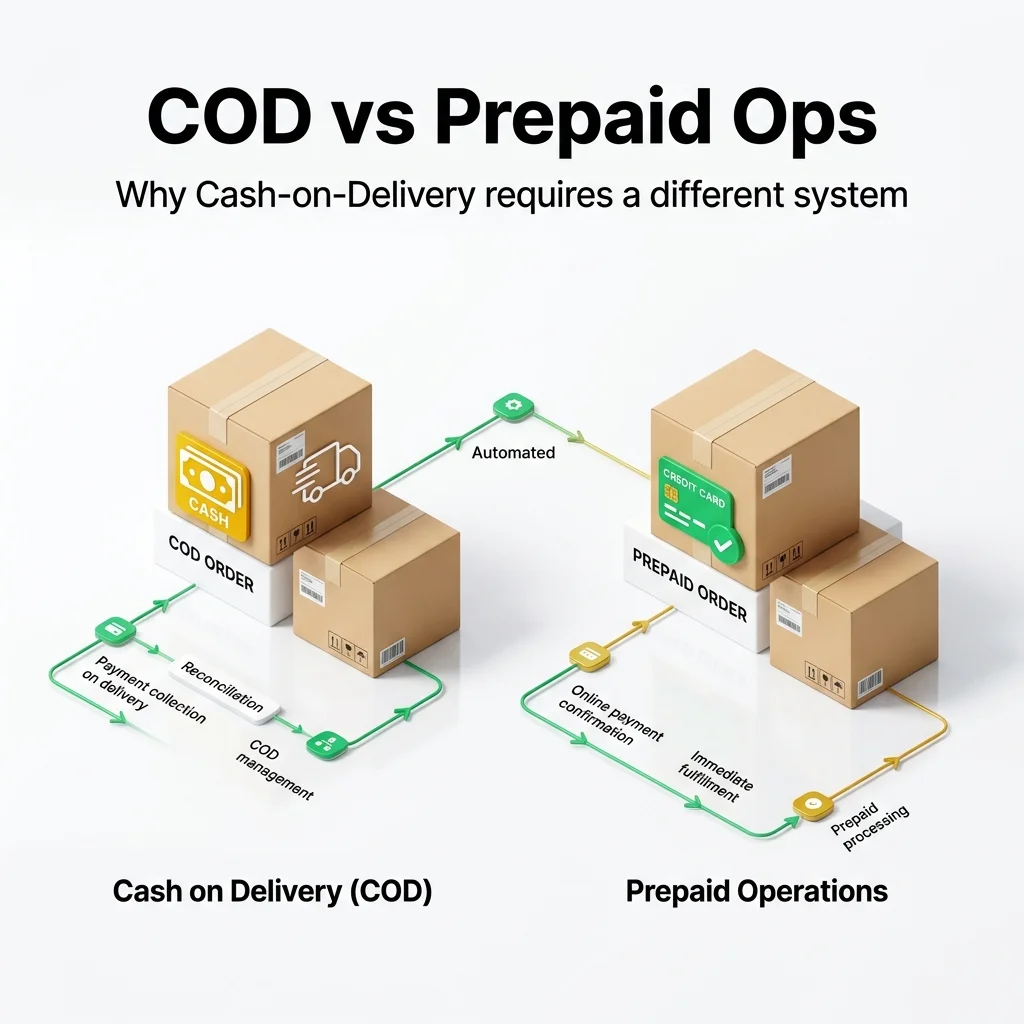
Most order management systems are built around a simple workflow: customer pays → order ships → delivered. This flow assumes payment risk is solved before fulfillment. COD flips this entirely. Payment uncertainty creates 5+ extra decision points between order placement and successful delivery.
OrdersPilot was built specifically for Indian D2C brands managing COD at scale. Here's why COD needs a fundamentally different approach.
Important
COD is not just a payment method; it's a completely different operational workflow that requires unique tracking, confirmation, and RTO management strategies.
The COD Complexity Problem
| Stage | Prepaid Workflow | COD Workflow |
|---|---|---|
| Payment | Upfront (Instant) | At Delivery (Uncertain) |
| Verification | Automated (Payment Gateway) | Manual (Calling Team Required) |
| Inventory | Guaranteed Allocation | Probable Allocation |
| Labeling | Instant Generation | Conditional on Confirmation |
| Fulfillment | Linear (Pick -> Pack -> Ship) | Dynamic (Hold -> Confirm -> Ship) |
| Risk | Minimal (Fraud only) | High (Customer Refusal/RTO) |
Where Prepaid Systems Break Down
System #1: Generic Order Management Dashboard A standard Shopify dashboard or generic OMS works great for "confirmed payment → ship → done." For COD, it's blind.
Problems:
- No order confirmation status
- No RTO tracking (Return to Origin rate)
- No calling queue for unconfirmed orders
- Can't assign orders to specific calling agents
- Zero visibility into payment attempt outcomes
System #2: Spreadsheet Chaos Many Indian D2C brands manage COD through shared Google Sheets or Excel:
- Calling team exports orders daily
- Manually updates confirmation status
- Shipping team sees stale data
- Inventory never syncs
- RTOs aren't tracked
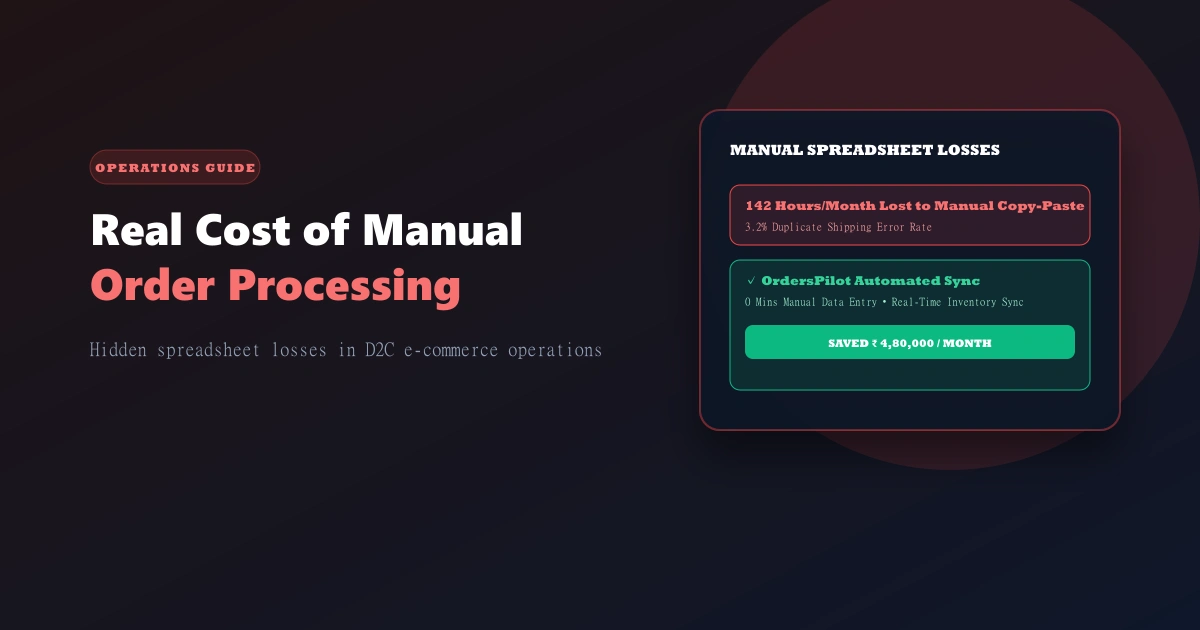
A store hitting 1,000 COD orders per day? Spreadsheet management turns into a full-time nightmare.
System #3: Disconnected Tools Shopify → CSV export → WhatsApp spreadsheet → courier dashboard → calling team notes. Data is fragmented. Someone always has stale information. Orders fall through cracks.
The OrdersPilot Difference: COD-First Architecture
OrdersPilot rebuilds the entire workflow around COD reality:
Real-Time Order Confirmation Queue
Instead of hoping your calling team saw the Shopify notification, OrdersPilot gives them a prioritized queue:
- Orders ranked by payment likelihood
- Assignment to specific agents
- Confirmation status tracked in real-time
- Callback tracking (customer didn't answer)
Intelligent Inventory Allocation
COD means payment is uncertain. OrdersPilot allocates inventory intelligently:
- Confirms inventory availability before calling
- Only marks items as "reserved" if payment confirmed
- Auto-cancels unconfirmed orders after 24 hours (configurable)
- Prevents overselling across multiple stores
Built-In RTO Management
RTOs destroy profit margins. OrdersPilot prevents them:
- Tracks RTO rate by courier, agent, and product
- Flags high-risk orders automatically
- Sends pre-emptive WhatsApp confirmations
- Logs RTO reasons for analytics
Multi-Courier Automation
No more manual waybill creation:
- Delhivery & Shiprocket APIs integrated natively
- One-click bulk shipment generation
- Automatic courier assignment based on pincode
- Tracking auto-synced to customer
Calling Team Dashboard
Your agents need a workspace, not a spreadsheet:
- Order queue with customer details
- One-click WhatsApp sending
- Payment confirmation buttons
- Call history and notes
- Performance metrics (confirmations/hour, callback rate)
Real-Time Analytics
Not spreadsheets three days later:
- Daily order count by confirmation status
- RTO rate by product/courier/agent
- Inventory levels across stores
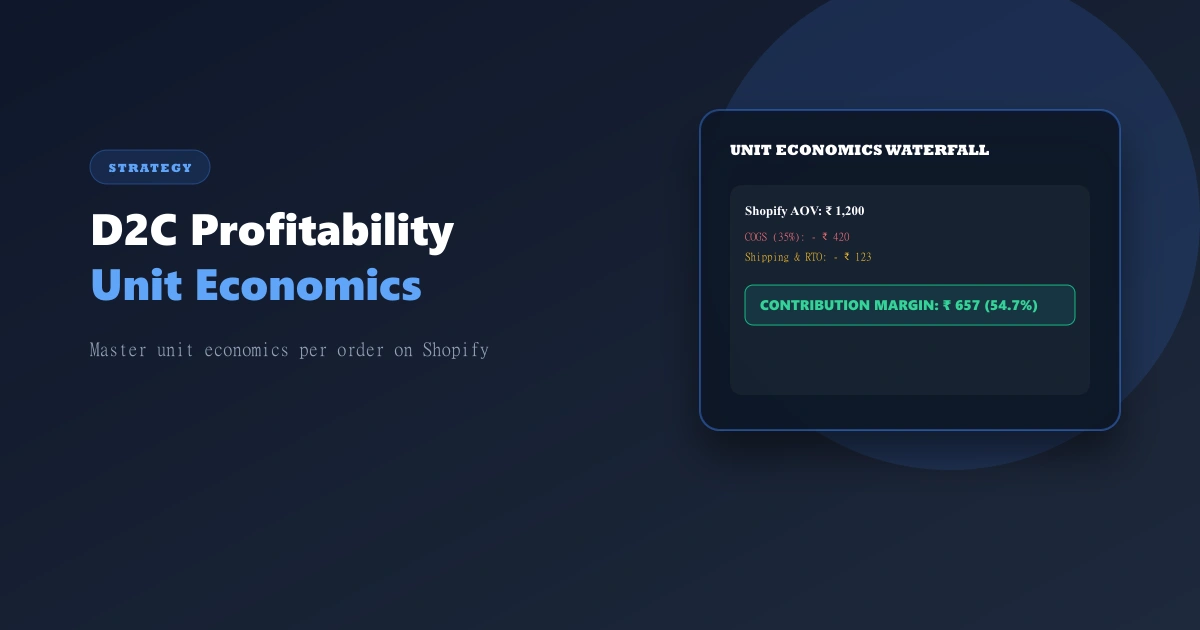
Every 1% reduction in RTO = 5-7% margin improvement. For a brand with ₹10 lakh GMV, dropping RTO from 18% to 7% results in a total monthly impact of ₹1,65,000.
Who Needs a COD-Specific System?
You need OrdersPilot if:
- ✅ 50%+ of orders are COD
- ✅ Running 500+ orders per day
- ✅ Managing a dedicated calling team
- ✅ Selling across Delhivery/Shiprocket zones
- ✅ Have inventory syncing issues
- ✅ Don't have RTO rate visibility
What Prepaid Systems Get Right
To be fair, prepaid-optimized systems excel at:
- Payment reconciliation (when all payment is upfront)
- Bulk fulfillment workflows
- International shipping (not a COD problem)
If you're primarily prepaid, a generic OMS works fine. But if COD is your lifeblood, you need a system built around COD's unique complexity.
The Path Forward
For Indian D2C brands, COD isn't a phase—it's foundational. 80%+ of online transactions in India are still COD. Building for scale means building systems that make COD operations scalable, profitable, and visible.
That's what OrdersPilot does.
Frequently Asked Questions (FAQ)
1. Why is COD higher risk than prepaid for D2C brands?
COD orders have a higher Return to Origin (RTO) rate because the customer has no financial commitment at the time of order. This leads to higher cancellation rates at the doorstep and increased logistics costs for the brand.
2. How can I reduce RTO for my Shopify store?
The most effective way to reduce RTO is through real-time order confirmation (via WhatsApp or calling teams), address verification, and using a data-driven courier strategy to avoid high-risk zones.
3. Does OrdersPilot integrate with Shopify?
Yes, OrdersPilot is built specifically for Shopify and syncs orders, inventory, and fulfillment status in real-time, providing a unified dashboard for multi-store operations.
Related Operations Guides
To further optimize your COD workflow, we recommend exploring these related resources:
- Automating Shipping Labels & Waybills: Scale your label printing to match your order growth.
- Reducing RTO Rates: D2C Case Study: See how these strategies work in a real production environment.
- WhatsApp Automation for RTO Prevention: The technical side of order confirmations.
Ready to transform your COD operations? Schedule a demo with our team. We'll show you how OrdersPilot turns chaos into clockwork.
Author
Growth Team
Deeply passionate about optimizing e-commerce logistics and building systems that help D2C founders regain control of their operations.
Enjoyed this article?
If you found this helpful, share it with your network and help other Shopify founders scale their operations.
Recommended Articles
Continue your journey with more insights from our team.