When a D2C brand scales from 5,000 orders to 100,000+ orders per month (over 1.2 Million orders per year), standard database queries begin to lag.
A dashboard query that took 50ms at 1,000 orders can take 4 to 8 seconds at 500,000 documents if proper database indexing is absent. Worse, courier webhook callbacks (such as Delhivery or Shiprocket tracking webhooks) can fail due to 500ms timeout SLAs, resulting in dropped tracking updates and broken customer notifications.
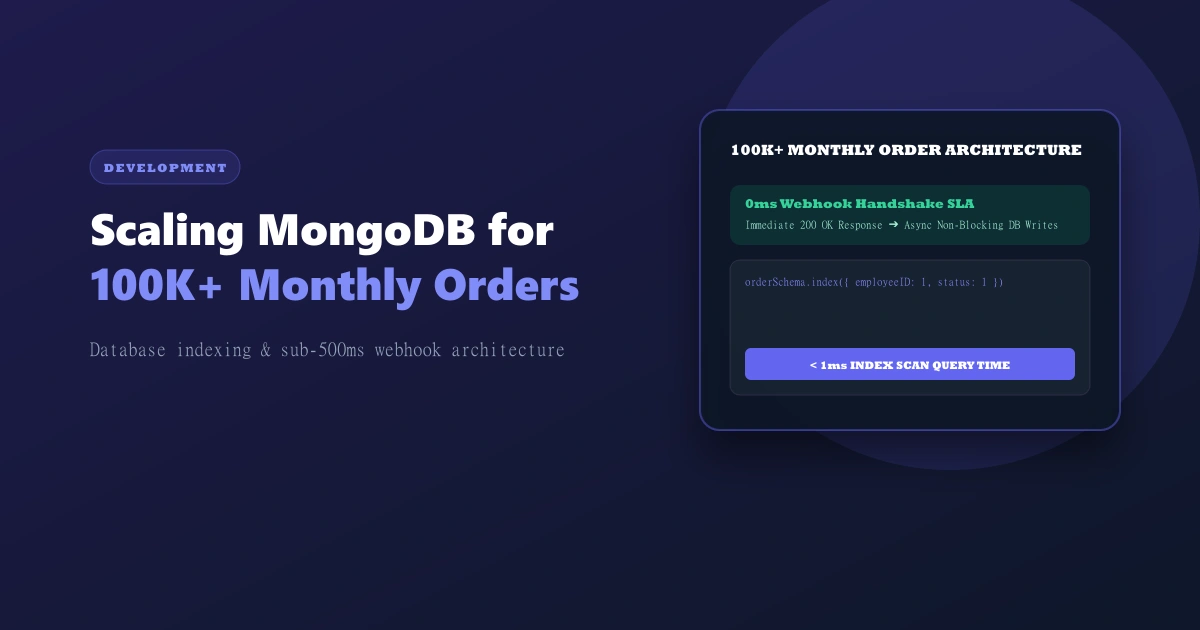
This technical guide outlines how OrdersPilot engineered its Node.js and MongoDB architecture to process 100K+ monthly orders with sub-1ms query times and instant non-blocking webhook processing.
Important
Courier APIs like Delhivery enforce a strict 500ms HTTP response SLA on webhooks. If your server performs heavy database writes before returning a 200 OK response, the courier will mark your endpoint as unresponsive and stop sending status updates.
1. The Non-Blocking Webhook Architecture (0ms Latency Response)
To satisfy strict courier SLAs, OrdersPilot splits webhook handling into two phases: Synchronous Handshake and Asynchronous Execution.
[Delhivery Webhook Request] ➔ [1. Validate Secret Header (~0ms)] ➔ [2. Send 200 OK Immediately]
                                                                             │
                                                                 (Background Event Loop)
                                                                             ▼
                                                              [3. Atomic Status Update & WA Nudge]
Node.js Controller Implementation Pattern:
exports.delhiveryWebhook = (request, response) => {
  // Step 1: Validate Secret Token (Memory check, ~0ms)
  const incomingToken = request.headers["x-delhivery-token"];
  if (incomingToken !== WEBHOOK_SECRET) {
    return response.sendStatus(401);
  }

  // Step 2: Return 200 OK IMMEDIATELY (satisfies <500ms SLA)
  response.sendStatus(200);

  // Step 3: Fire-and-Forget Background Processor (Async)
  processShipmentUpdateAsync(request.body?.Shipment);
};
2. Compound Indexing Strategy for 1.2M+ Orders/Year
Without indexes, MongoDB must perform a Full Collection Scan (COLLSCAN), reading every single document in the collection to return results.
OrdersPilot utilizes strategic Compound Performance Indexes on the Order schema to ensure queries execute via Index Scans (IXSCAN) in < 1ms:
// High-frequency calling team queue queries (employeeId + status)
orderSchema.index({ employeeID: 1, orderStatus: 1 });

// Daily performance reporting & time-series analytics
orderSchema.index({ operationDate: -1, employeeID: 1 });
orderSchema.index({ orderDate: -1, orderStatus: 1 });

// Instant waybill tracking lookup via courier webhooks
orderSchema.index({ "waybillDetails.wayBill": 1 });

// Delivery status aggregation
orderSchema.index({ isWaybillGenerated: 1, "waybillDetails.status": 1 });
3. Pre-Aggregated Daily Counters vs. Live Aggregation Pipelines
Calculating real-time confirmation, delivery, and RTO stats by running $group aggregation pipelines over 500,000 order documents on every dashboard load is extremely CPU intensive.
OrdersPilot utilizes Pre-Aggregated Incremental Counter Models (EmployeeDailyStats and EmployeeProductDailyStat).
Whenever an order status transitions (e.g., Confirmed or Delivered), an atomic $inc update runs:
await EmployeeDailyStats.findOneAndUpdate(
  { employeeId: agentId, operationDate: dayStart, fromDraft: false },
  { $inc: { confirmed: 1, totalCalls: 1 } },
  { upsert: true }
);
When an admin opens the dashboard, the server reads a single pre-aggregated document instead of processing 100,000 individual order records!
Performance Comparison: Unoptimized vs. OrdersPilot Architecture
| Standard Unoptimized Setup | OrdersPilot High-Scale Engine |
|---|---|
| 3.5s - 8.0s Dashboard Load Time | < 40ms Dashboard Response Time |
| Dropped webhooks due to 500ms timeouts | 0ms Handshake SLA Compliance |
| Heavy MongoDB CPU spikes during sale events | Low memory footprint via $inc counters |
Frequently Asked Questions (FAQ)
1. Why return 200 OK before saving to the database?
If your database connection experiences temporary latency, returning 200 OK first guarantees the courier webhook will not timeout or mark your webhook URL as broken.
2. How do you prevent race conditions when two webhooks arrive simultaneously?
OrdersPilot uses MongoDB findOneAndUpdate with conditional updates ("waybillDetails.status": { $ne: newStatus }), ensuring atomic state changes and preventing redundant updates.
Related Tech Guides
- How to Setup Shopify Webhooks for Real-Time Automation: Setting up Shopify event hooks.
- Shopify Flow vs. Custom Automation: When to use custom code vs native Flow.
Building high-scale D2C infrastructure? Schedule a demo with OrdersPilot to experience our lightning-fast operations platform.
Author
Tech Team
Deeply passionate about optimizing e-commerce logistics and building systems that help D2C founders regain control of their operations.
Enjoyed this article?
If you found this helpful, share it with your network and help other Shopify founders scale their operations.
Recommended Articles
Continue your journey with more insights from our team.